Cloud opacities tutorial
This tutorial shows how to create cloud opacity objects and compute their extinction coefficient spectra for a given atmospheric profile.
Note
You can also find this tutorial as a jupyter notebook here.
[1]:
# Lets start by importing some useful modules
import pyratbay.atmosphere as pa
import pyratbay.spectrum as ps
import pyratbay.opacity as op

import matplotlib.pyplot as plt
import matplotlib
import numpy as np
1. Lecavelier (Rayleigh-like) model
[2]:
# We will sample the opacity over a constant-resolution wavelength array
# (boundaries in micron units)
wl_min = 0.2
wl_max = 6.0
resolution = 15000.0
wl = ps.constant_resolution_spectrum(wl_min, wl_max, resolution)

# Atmospheric pressure profile in bars:
nlayers = 81
pressure = pa.pressure('1e-8 bar', '1e2 bar', nlayers)

# Parametric model based on Lecavelier des Etangs (2008) model for H2:
lecavelier = op.clouds.Lecavelier(pressure, wl=wl)

print(lecavelier)
Model name (name): 'lecavelier'
Pressure array (pressure, bar): 1e-08 ... 100.0
Number of model parameters (npars): 2
Parameter name     Value
  (pnames)         (pars)
  log_k_ray         0.000e+00
  alpha_ray        -4.000e+00
Wavenumber (wn, cm-1):
   [50000.00 49996.67 49993.33 ... 1667.00 1666.88 1666.77]
Cross section (cross_section, cm2 molec-1):
   [ 4.980e-26  4.979e-26  4.978e-26 ...  6.153e-32  6.152e-32  6.150e-32]
The Lecavelier() model implements a power-law cross section (i.e., non-gray) with two parameters that set the strength (\(\log\kappa_{\rm ray}\)) and slope (\(\alpha_{\rm ray}\)) of the absorption:
\[k(\lambda) = \kappa_{\rm ray}\ \kappa_0 \left(\frac{\lambda}{\lambda_0}\right)^{\alpha_{\rm ray}}\]
with constants \(\lambda_0=0.35\) um and \(\kappa_0=5.31 \times 10^{-27}\) cm2 molecule-1.
[3]:
# Evaluate extinction coefficients
temperature = np.tile(1800.0, nlayers)
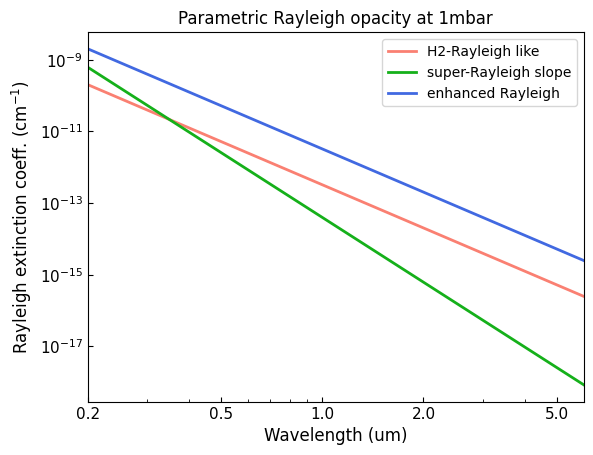
# log_kappa_ray = 0.0 and alpha_ray = -4 reproduces H2-Rayleigh opacity
rayleigh_ec = lecavelier.calc_extinction_coefficient(
    temperature, pars=[0.0, -4.0],
)

# A super-Rayleigh slope
super_ray_ec = lecavelier.calc_extinction_coefficient(
    temperature,
    pars=[0.0, -6.0],
)

# Enhanced Rayleigh-like absorption
enhanced_ray_ec = lecavelier.calc_extinction_coefficient(
    temperature,
    pars=[1.0, -4.0],
)


plt.figure(2)
plt.clf()
ax = plt.subplot(111)
ax.plot(wl, rayleigh_ec[40], color='salmon', lw=2.0, label='H2-Rayleigh like')
ax.plot(wl, super_ray_ec[40], color='xkcd:green', lw=2.0, label='super-Rayleigh slope')
ax.plot(wl, enhanced_ray_ec[40], color='royalblue', lw=2.0, label='enhanced Rayleigh')
ax.set_xscale('log')
ax.set_yscale('log')
ax.xaxis.set_major_formatter(matplotlib.ticker.ScalarFormatter())
ax.set_xticks([0.2, 0.5, 1.0, 2.0, 5.0])
ax.tick_params(which='both', direction='in', labelsize=11)
ax.set_xlim(np.amin(wl), np.amax(wl))
ax.set_xlabel('Wavelength (um)', fontsize=12)
ax.set_ylabel('Rayleigh extinction coeff. (cm$^{-1}$)', fontsize=12)
ax.legend(loc='upper right')
ax.set_title('Parametric Rayleigh opacity at 1mbar')
[3]:
Text(0.5, 1.0, 'Parametric Rayleigh opacity at 1mbar')
[4]:
# Get VMRs in thermochemical equilibrium for a simple mix of species
# and their number-density profiles under IGL (molecules per cm3)
species = ['H2', 'H', 'He']
net, specs, vmr = pa.chemistry('equilibrium', pressure, temperature, species)
number_densities = pa.ideal_gas_density(vmr, pressure, temperature)

H2_density = number_densities[:,0]

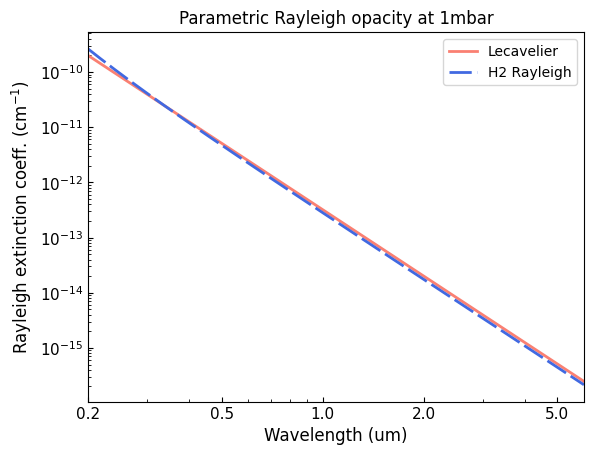
# Compare to H2 absorption
H2_rayleigh = op.rayleigh.Kurucz(wn=1e4/wl, species='H2')
H2_ec = H2_rayleigh.calc_extinction_coefficient(H2_density)

# See results:
plt.figure(2)
plt.clf()
ax = plt.subplot(111)
ax.plot(wl, rayleigh_ec[40], color='salmon', lw=2.0, label='Lecavelier')
ax.plot(wl, H2_ec[40], color='royalblue', lw=2.0, dashes=(8,2), label='H2 Rayleigh')
ax.set_xscale('log')
ax.set_yscale('log')
ax.xaxis.set_major_formatter(matplotlib.ticker.ScalarFormatter())
ax.set_xticks([0.2, 0.5, 1.0, 2.0, 5.0])
ax.tick_params(which='both', direction='in', labelsize=11)
ax.set_xlim(np.amin(wl), np.amax(wl))
ax.set_xlabel('Wavelength (um)', fontsize=12)
ax.set_ylabel('Rayleigh extinction coeff. (cm$^{-1}$)', fontsize=12)
ax.legend(loc='upper right')
ax.set_title('Parametric Rayleigh opacity at 1mbar')
Compute chemical abundances.
[4]:
Text(0.5, 1.0, 'Parametric Rayleigh opacity at 1mbar')