Repack line sampling
Sometimes, computing cross-section spectra from billions of line
transitions becomes unfeasible. For such cases, the repack tool [Cubillos2017b] helps
to identify and retain the strong line transitions that dominate the
spectrum. repack effectively the line list down to millions, without
significantly impacting the cross section spectra. This tutorial shows
how to fetch line lists that have been pre-processed with repack,
and sample them into cross-section files for use in Pyrat Bay
radiative-transfer calculations.
Pyrat Bay has a two-step process to process line lists:
Convert line lists from their original format (e.g., HITRAN
.parfiles, ExoMol.states/.transfiles) into transition-line information files (TLI files). This is simple a re-formatting step, the data is still kept as the info per line-transition (wavelengths, gf, Elow, isotope). TLI files can readily be used forPyrat Bayradiative-transfer calculations, but such runs are slow as the code computes the lines shape and strength on the fly to obtain the cross sections.Conver TLI files into cross-section tables (saved as Numpy
.npzfiles). This step evaluates (i.e., samples) the line-transition information over a grid of [wavelength, temperature, pressure], which involves computing the line shape and strength of all lines at each given wl, pressure, and temperature value of the grid. Cross-section tables are ideal for radiative-transfer calculations, since the code simply interpolates from them (and therefore, these calculations are fast).
The main issue with cross-section is that they are not too flexible (one
might want to change, e.g., the wavelength resolution or line broadening
parameters, for which the user would need to re-generate cross-sections
from the TLI files). For this reason Pyrat Bay was designed with
this two-step approach.
Download Repack data
You can find ExoMol-repacked line lists from this Zenodo repository (DOI: 10.5281/zenodo.3768503):
The following table shows species already processed with repack and
are ready for use:
Species/link |
Database name |
Isotopologues |
References |
|---|---|---|---|
pokazatel |
116 |
||
mm |
2111 |
||
ai3000k |
266, 366, 628, 627 |
||
ucl4000 |
266 |
||
coyute |
4111, 5111 |
||
toto |
66, 76, 86, 96, 06 |
||
hyvo |
16 |
||
harris & larner |
124, 134 |
||
exoames |
266 |
||
ayt2 |
112 |
||
acety |
2211 |
For this demo, we will work with the VO repack line list. We fetch the data can do this with the following prompt commands:
# Download the data
wget https://zenodo.org/records/14266247/files/VO_exomol_hyvo_0.22-50um_100-3500K_threshold_0.01_lbl.dat
wget https://www.exomol.com/db/VO/51V-16O/HyVO/51V-16O__HyVO.pf
Format partition functions
Before generating the TLI file, we will format the partition-function
files from ExoMol for use in Pyrat Bay. We can do this with the
following prompt command where we first specify the source (exomol)
and then list all ‘.pf’ files of interest (one can combine multiple
isotopologues of a species into a single file):
If the ExoMol .pf files sample the temperature range of interest. Then use their .pf files directly:
pbay -pf exomol 51V-16O__HyVO.pf
Alternatively, if you expect to probe higher temperatures than those sample in the .pf files, the we can compute the partitions from the .states files with the command below. Here one specifies the temperature ranges and sampling step.
#             T_low  T_high  delta_T
pbay -pf states 5.0  10000.0  5.0  51V-16O__HyVO.states
This will produce the PF_exomol_VO.dat file, which can be passed as input for the TLI config file.
Compute TLI files
The easiest way to generate TLI files is via configuration files and
the command line. The config file below converts the repack ExoMol/VO
line-lists (see dblist) into a TLI file (see tlifile or
logfile). The partition-function information must also be
provided (see pflist).
Lastly, the user can specify the wavelength range of the extracted data
(see wl_low and wl_high). Normally one want to the widest possible
range (to avoid needing to re-calculating TLI files if a future
calculation needs it), but for sake of this demo, we will extract just
over a narrow region:
[pyrat]

# Pyrat Bay run mode: [tli atmosphere spectrum opacity retrieval radeq]
runmode = tli

# Output log and TLI file (if you ommit `tlifile`, it will be automatically generated from the logfile):
logfile = exomol_repack_VO_0.3-30.0um.log

# List of line-transtion databases:
dblist = VO_exomol_hyvo_0.22-50um_100-3500K_threshold_0.01_lbl.dat

# Type of line-transition database, select from:
# [hitran exomol repack]
dbtype = repack

# List of partition functions for each database:
pflist = PF_exomol_VO.dat

# Initial and final wavelength:
wl_low = 0.3 um
wl_high = 30.0 um

# Verbosity level [1--3]:
verb = 2
To generate the tli files, we run these Pyrat Bay prompt commands:
pbay -c line_sample_repack_VO_tli.cfg
Compute cross-section tables
As with TLI files, cross-section files can be generated via
configuration files and the command line. The config file below
computes a cross-section table (with the output name determined by the
sampled_cross_sec or logfile parameters).
These parameters define each array of the cross-section table:
The
pbottom,ptop, andnlayersparameters define the pressure sampling arrayThe
tmin,tmax, andtstepparameters define the temperature sampling arrayThe
wl_low,wl_high, andresolutionparameters define the spectral array at a constant resolution (alternatively, one can replaceresolutionwithwnstepto sample at a constant \(\Delta \text{wavenumber}\), units in cm\(^{-1}\))
For the composition (species), make sure to include the molecule for
which we are computing the cross-sections. Also, include the
background gas, which is relevant for the pressure broadening (here,
we assume a H2/He-dominated atmosphere). Only the VMR values of the
background gasses are important, trace-gas VMRs are irrelevant (see
chemistry or uniform_vmr. tmodel and tpars are needed to
define the atmosphere’s temperature profile, but for an opacity run,
these do not impact the calculations.
The optional voigt_extent and voigt_cutoff keys set the extent
of the profiles wings from the line centers. voigt_extent sets
the maximum extent in units of HWHM (default is 300 HWHM).
voigt_cutoff sets the maximum extent in wavenumber units of cm-1 (default is 25.0 cm-1). For any given profile, the
code truncates the line wing at the minimum value of either
voigt_extent or voigt_cutoff.
Lastly, the user can set ncpu to speed up the
calculations using parallel computing.
[pyrat]

# Pyrat Bay run mode: [tli atmosphere spectrum opacity retrieval radeq]
runmode = opacity

# Output log and cross-section file:
# (if you ommit extfile it will be automatically generated from logfile name)
logfile = cross_section_R025K_0150-3000K_0.3-30.0um_exomol_VO_hyvo.log

# Input TLI file:
tlifile = exomol_repack_VO_0.3-30.0um.tli

# Pressure sampling:
pbottom = 100 bar
ptop = 1e-8 bar
nlayers = 51

# Temperature profile (needed, but not relevant for cross-section generation)
tmodel = isothermal
tpars = 1000.0

# A simplified H2/He-dominated composition
chemistry = free
species = H2  He  VO
uniform_vmr = 0.85 0.15 1e-4

# Wavelength sampling
wl_low = 0.3 um
wl_high = 30.0 um
resolution = 25000.0

# Extent of the Voigt profile wings (in HWHM and in cm-1, respectively):
#voigt_extent = 300.0
#voigt_cutoff = 25.0

# Cross-section temperature sampling:
tmin =  150
tmax = 3000
tstep = 150

# Number of CPUs for parallel processing:
ncpu = 16

# Verbosity level [1--3]
verb = 2
To generate the cross-section files, run this Pyrat Bay prompt
command:
pbay -c line_sample_repack_VO_opacity.cfg
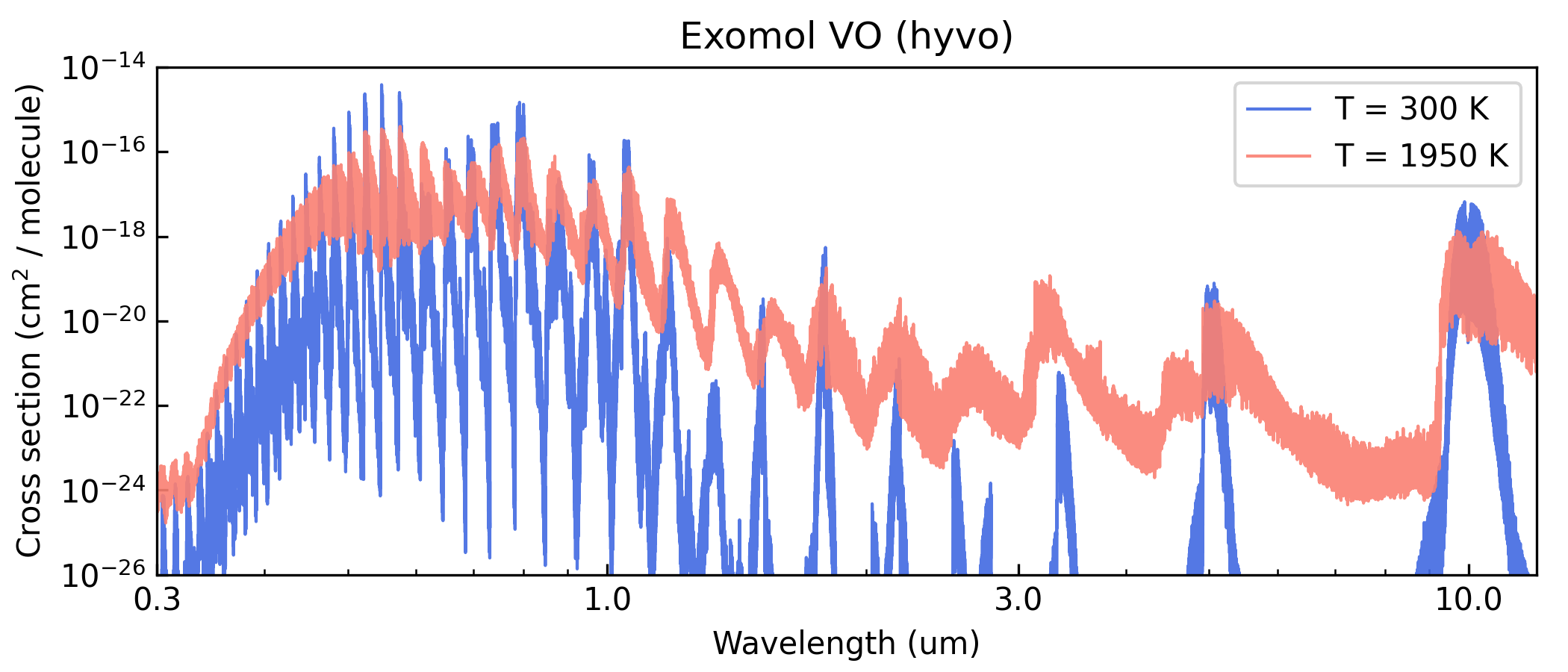
Here’s a Python script to take a look at the output cross section:
import pyratbay.io as io
import matplotlib
import matplotlib.pyplot as plt

cs_file = 'cross_section_R025K_0150-3000K_0.3-30.0um_exomol_VO_hyvo.npz'
units, mol, temp, press, wn, cross_section = io.read_opacity(cs_file)

p = 35
wl = 1e4/wn
colors = 'royalblue', 'salmon'

fig = plt.figure(0)
plt.clf()
fig.set_size_inches(7, 3)
plt.subplots_adjust(0.1, 0.145, 0.98, 0.9)
ax = plt.subplot(111)
for i,t in enumerate([1,12]):
    label = f'T = {temp[t]:.0f} K'
    plt.plot(
        wl, cross_section[t,p], lw=1.0,
        color=colors[i], alpha=0.9, label=label,
    )
plt.xscale('log')
plt.yscale('log')
ax.xaxis.set_minor_formatter(matplotlib.ticker.NullFormatter())
ax.xaxis.set_major_formatter(matplotlib.ticker.ScalarFormatter())
ax.set_xticks([0.3, 1.0, 3.0, 10.0])
plt.xlim(0.3, 12.0)
plt.ylim(1e-26, 1e-14)
plt.title('Exomol VO (hyvo)')
plt.xlabel('Wavelength (um)')
plt.ylabel(r'Cross section (cm$^{2}$ / molecule)')
plt.legend(loc='upper right')
ax.tick_params(which='both', direction='in')